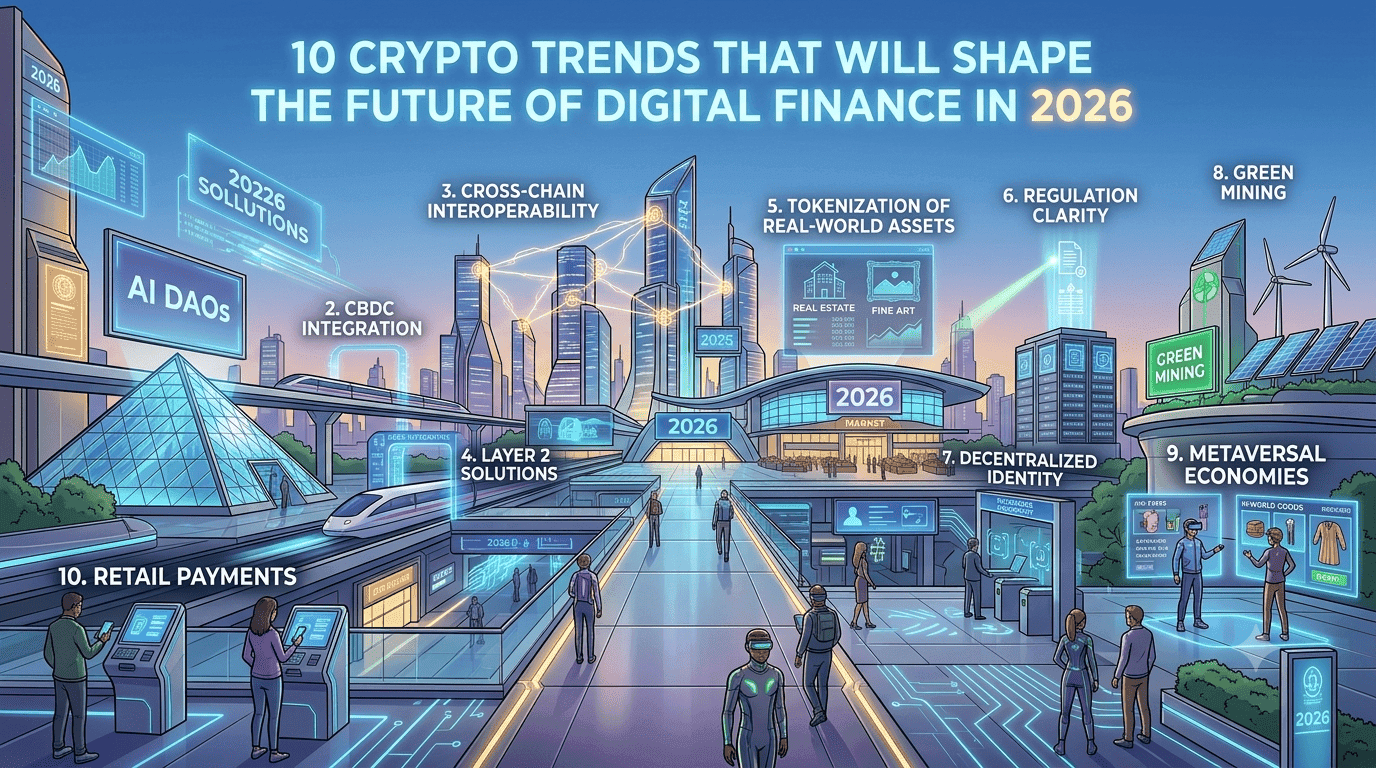
The global crypto token market is expected to grow significantly over the next decade, with estimates placing the total market size between $5 trillion and $10 trillion by 2026, and potentially $10 trillion to $18 trillion by 2030.
The digital finance world is changing at a breakneck pace through innovation, regulation, and the expanding adoption. By 2026, the use of cryptocurrency will keep pushing the boundaries as blockchain technologies will be even more involved in the global financial systems. With the emergence of the decentralized finance (DeFi) and the stablecoins up to tokenized assets of the real world and the automation advanced by artificial intelligence, the future is filled with the seismic shifts affecting investors, institutions, and even ordinary users.
This is a complete guide to the best trends in Cryptocurrency that will transform the digital finance space in 2026 and even further.
Stablecoins Moves to Core Financial Infrastructure
The emergence of stablecoins, digital assets tied to fixed reserves, such as the U.S. dollar has been one of the greatest crypto trends in recent years. The overall market cap of stablecoins increased approximately 50 percent in 2025 and it is projected that by 2026, stablecoins would have surpassed trading instruments in digital finance and become a payment and settlement rail.
Cross-border payment, remittance, payroll systems, and Treasury operations have seen a rise in the use of stablecoins being faster and cheaper than the traditional systems. This adoption pattern of cryptocurrencies highlights the fact that digital currencies are approaching mainstream financial infrastructure and the boundary between Web3 and conventional finance is blurred.
DeFi Grows as Institutions Enter
Decentralized finance which at one point encompassed a fringe experiment - is today one of the most radical Crypto trends in modern finance. In the DeFi protocols, it is estimated that total value locked will reach over 200 billion dollars in 2026 as the industry comes out of recovery and growth phase following the hardships of previous market cycles.
In contrast to the conventional banking system, DeFi systems provide lending, borrowing, and trading facilities with no intermediaries, which increase accessibility and transparency. Institutional actors are currently seeking regulated and sanctioned DeFi engagement, combining regulation with the programmable efficiency of blockchain. With this going on, DeFi may compete with legacy systems in settlement, credit markets and on chain derivatives - a vital component of the emerging digital finance ecosystem.
CRWA Surges in Tokenization
The year 2026 might be the one when tokenization stops being a theory and starts having effective effects. Real-world assets (RWAs) are tokenized on blockchain networks (real estate, bonds, commodities, and equity) as the number of such offerings grows. Fractional ownership and access to high-value assets worldwide opens up hitherto illiquid markets through tokenization.
The market is projected to see a 200 percent growth in volume of tokenization, to over 54 billion by 2026, with institutional demand and regulatory sanity. Not only does this tendency of cryptocurrency penetration into the conventional market democratize the investment process, but also opens new programmable and transparent asset classes, which is one of the main elements of the digital economy in the future.
Interoperability between Chains Goes Standard
Blockchain networks have mostly been siloed in the past years, with different networks having different asset standards and communication. The second trend in Cryptos is interoperability across chains - allowing assets and data to freely flow across different blockchains.
Complex protocols and messaging layers (e.g. Cosmos IBC, LayerZero, Chainlink CCIP) are being made available to bridge seamlessly across ecosystems, preventing liquidity fragmentation and developing composable financial products.
This interoperability is not the technical novelty per se - it is directly beneficial to the users as it:
- Tapping into wider liquidity bases
- Improving the multi-chain decentralized applications
- Cutting down on wastages in asset transfers
Consequently, it might happen that on the year 2026, the multi-chain experiences will be the rule, rather than the exception.
AI + Blockchain Intersect to Smarter Finance
The combination of artificial intelligence (AI) with blockchain technology is one of the most impactful trends in cryptocurrencies in the future. Predictive analytics and automated trading bots to AI-driven decentralized autonomous organizations (DAOs): AI is expanding the capabilities of blockchain beyond the recording of transactions.
AI will be able to optimize the liquidity pools, identify fraud, and automate the portfolio strategies, and blockchain will guarantee transparency, security, and verifiable transactions.
Such synergy will trickle down to DeFi, trading, asset management, and even identity verification in making crypto systems smarter and accessible to users at different degrees of expertise. By 2026, AI-based solutions will become a regular aspect of crypto platforms, which would make its efficiency and interaction with users more significant.
One analysis projects the global blockchain market could reach around $108 billion by 2026 and approach nearly $400 billion by 2028, reflecting massive investment across finance, logistics, healthcare, and more.
6. NFTs Evolve From Collectibles to Utility Assets
Previously known as a digital art synonym, NFTs (non-fungible tokens) are undergoing a paradigm shift of purpose which is another trend of Crypto that is defining the future. NFTs will be practically used as working digital assets in 2026 and will go well beyond profile pictures, including:
- Subscription and membership rights
- Economic ecosystems on virtual property
- Credential systems and event ticketing
- The management of intellectual property
This growth makes NFTs not a futuristic object but a tool to be used in a larger digital and physical context. NFTs might be a component of access control, digital identity, game economies, and tradable loyalty systems - as useful to Web3 utility as real-world applications.
7. AI-Powered Trading and Investment Tools Gain Traction
Implementation of AI into crypto systems is going beyond the infrastructure and the ways that individuals are trading and investing are also changing. The spread of AI-based trading systems that provide: is one of the future cryptocurrency trends of 2026.
- Live market forecasting
- Risk management automation
- Pattern identification and strategy improvement
- Individualized investment notifications
These tools can assist experienced and new traders navigate volatility and find opportunities, both big and small, in both Bitcoin and Ethereum and altcoins.
This democratisation would make higher-level trading strategies previously only accessible to institutional investors accessible to crypto investors and make the investment more data-oriented and intuitive.
8. Regulatory Clarity Drives Mainstream Adoption
Regulation has been among the largest variants in the sentiment of the crypto market historically. Nonetheless, 2026 is likely to offer more regulatory clarity as governments will be developing systems that not only safeguard investors but also encourage innovation.
Particularly, the collaborative work on government-related stablecoins and digital payment is an indication of the fresh period of cooperation between the authorities and blockchain developers.
Clearer rules will likely:
- Enhance institutional trust
- Minimize fraud and market abuse
- Elaborate taxation and compliance
- Promote mainstream financial incorporations
Such innovations contribute to the legitimization of digital assets and introduce and increase the pace of adoption in global marketplaces and support a more predictable environment of innovation.
9. Cryptocurrency Adoption in Institutions Strengthens
The next defining Crypto trend that is influencing digital finance is the rising presence of institutional capital. Family offices, hedge funds and big companies are putting some of their portfolios into digital assets, a marked change since before they were very skeptical about structural acceptance.
10. Markets with Potential Fuel Cryptocurrency Adoption
Lastly, not everything is even in the rise of cryptocurrency on the global front, yet the use of cryptocurrency in emerging markets is increasing at a very fast rate. Areas such as Africa are using crypto to achieve financial inclusion, remittances and savings in economies with limited access to traditional banks.
Small businesses and individuals are getting empowered with mobile-first innovations and the use of stablecoins with:
- Lower transfer fees
- Quick global transactions
- Other savings schemes in unstable economies
This trend is one of the most anthropocentric aspects of cryptocurrency development, and it demonstrates how global economic resilience and inclusion may be supported using digital finance.
Build Your Next Cryptocurrency App with Markeltree
We are moving into 2026, and trends in cryptocurrency are transforming what can be done in digital finance. Stablecoins and DeFi, to tokenization, convergence in AI and institutional participation, all these trends highlight a larger change in the shift in which blockchain technologies would no longer be viewed as a niche interest group, but as infrastructure building blocks of the global economy.
These trends in cryptocurrencies are the indicators that digital assets are not speculative tools anymore. They are turning out to be practical additions to financial systems with all the speed, accessibility and transparency seemingly impossible before.
As a developer, investor, or even a curious bystander, it will be worth knowing these 10 significant trends in Crypto to help you sail in the ever-changing digital finance environment and predict the prospects and threats ahead. At Markeltree, we specialize in helping businesses and investors leverage these trends through innovative crypto solutions, from blockchain integration to strategic consulting, ensuring you stay ahead in the digital finance revolution.