In the modern digitalized world where many businesses operate in contemporary organizations, the success of a business greatly depends on the good software that is written to ensure that operations are made easier, customer experiences improved, and a business keeps ahead of the competition. Thoughtful journey is the core of every successful application, the beginning of an idea to a fully operated code. Software design and development is both an art and a science because this is a creative, strategic and technical journey. In the intro stage, more and more contemporary organizations resort to professional software design services to make sure that their ideas are implemented in the form of scalable, efficient, and user-friendly digital solutions.
Learning about the Concept Phase
All fabulous software products start with an idea. The stage is concerned with problem identification, goal setting, and the knowledge of the users who will be interacting with the system. Designers, stakeholders, and developers engage in communication with one another to make clear their requirements and to align their expectations.
The concept stage may cover market research, competitor analysis and stakeholder interviews. These steps guarantee the idea to be innovative and not just a simple fantasy that is not in line with the real world needs. The absence or haste of making this step may lead to software that does not achieve business goals or user demands.
The Significance of Software Design
After a conceptualization, attention moves to design. Software design is much more than the visual appeal as it determines how the system would operate, how it would grow and develop with time. This phase incorporates user experience (UX) design as well as system architecture planning.
UX design will provide the software to be user-friendly, convenient, and interesting. The user journeys, prototypes, and wireframes allow visualising the interaction with the product. Meanwhile, system design also outlines data structures and integrations as well as workflows that facilitate performance and security.
Design phase ensures the development risks are reduced, future rework is minimized, and a proper road map is made towards development is established by the design phase.
Closing the Gap Between Design and Development
The gap between design and development is one of the largest problems in software projects. Effective teams do not regard design and development as processes but as interrelated processes.
Documentation, design systems and team collaboration tools assist in making sure that developers properly translate design concepts into operating code. Frequent feedback between designers and developers permits the detection of problems at an earlier point in time, which also wastes time and resources.
This co-operation makes sure that there is uniformity in the product and assist in keeping the original vision through the development lifecycle.
The Development Process: How to Code Ideas
Development is the place where concepts and designs are transpired. Developers create the functionality of the software itself in the programming languages, frameworks, and tools. A current development usually adheres to one of the agile or iterative development approaches where the team can release features in phases and respond to feedback fast.
The main points of successful software development are:
- Writing maintainable code
- Adhering to code standards and good practices
- Performing security and performance optimization
- Carrying out routine testing and quality checking
The latter helps teams to develop faster and deliver high quality by dividing the development into manageable sprints.
Testing and Quality Assurance
There is no complete software, which has not been tested properly. Quality assurance guarantees that the application works as expected in devices, platforms and use cases. This stage detects bugs, performance and usability problems even prior to the product being made available to the users.
Testing can involve unit testing, integration testing, user acceptance testing and security tests. The fixes made at this early position would help avoid expensive repairs once the product has been launched and instills the confidence that the end product will be successful.
Continuous Improvement and Deployment
Once the software is developed and tested, it is deployment ready. But the journey has not yet reached its end. Monitoring of the post-launch, user feedback and performance analytics are a good source of information on how the service can be improved in the future.
Continuous improvement is adopted in modern software development. The software undergoes regular updates, new features, and optimization to keep up with the business demands to make it relevant and competitive.
The Importance of the End-to-End Approach
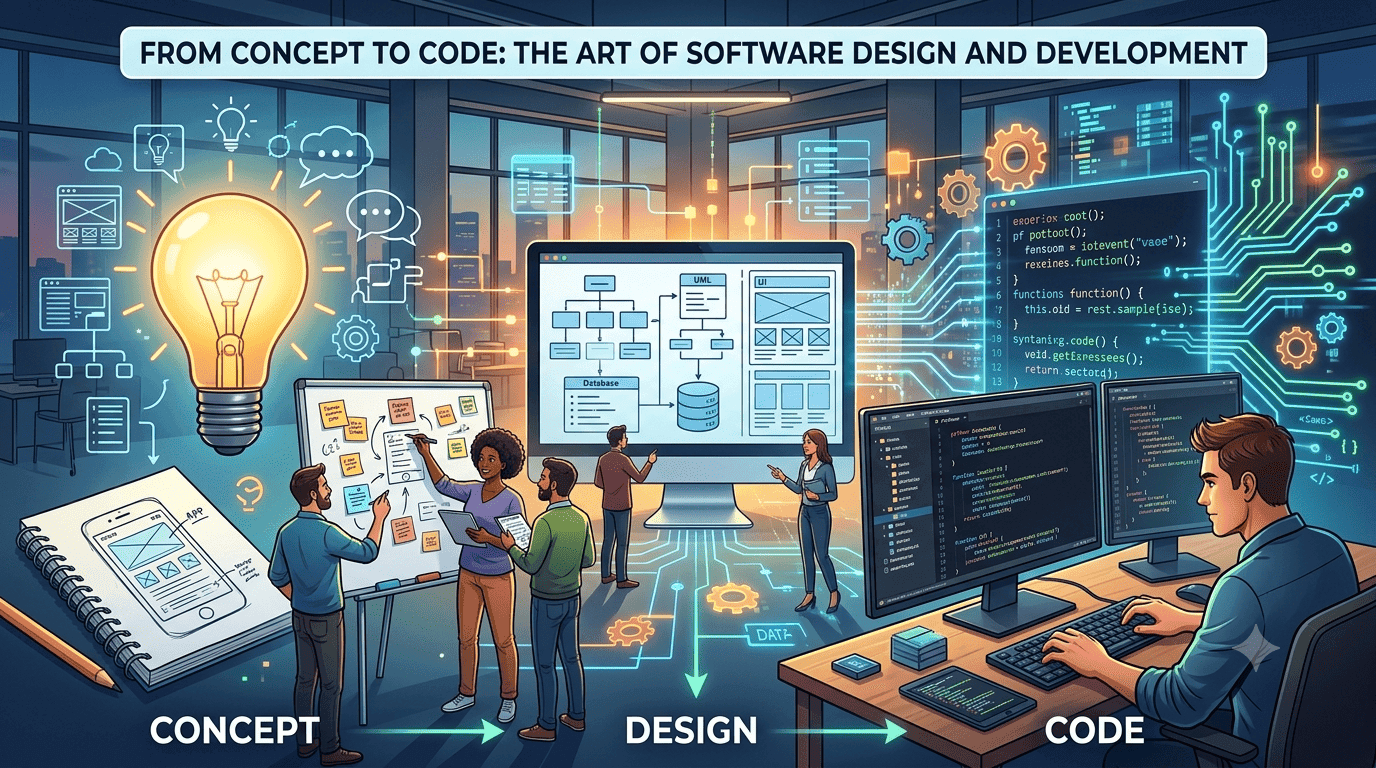
The real software design and development art is to perceive the process as a continuum in the form of concept to code and so on. One stage affects another one, and alignment, communication, and expertise will make the difference in the lifecycle.
Firms investing in an end-to-end model with a structured approach enjoy lower risks, shorter time-to-market, and long-term value software.
Final Thoughts
Software design and software development involve a combination of strategy, creative thinking and technical expertise between the creation of a rough draft and the creation of a refined digital product. Companies that collaborate with teams that have experience will be able to transform complex issues into the strength of solutions. A current example of organizations using an intelligent, end-to-end process to bring ideas to scalable, high-performing software that leads organizations to tangible business change is companies like Markeltree.